
Following a comprehensive overview of user stories, a fundamental concept in Agile software development. It explores user stories from the customer’s perspective, emphasizing the importance of answering the “what, whom, why, and when” questions. Furthermore, it delves into the customer-centric nature of user stories, the role of acceptance criteria and Definition of Done (DoD) in ensuring quality, and the application of the INVEST mnemonic to create effective user stories.
What is a User Story?
A user story is a short, simple description of a feature told from the perspective of the person who desires the new capability, usually an end-user or customer of the system. It captures what the user wants to achieve, who the user is, why they want it, and sometimes when they need it. User stories are a cornerstone of Agile methodologies, particularly Scrum and Kanban, serving as a lightweight and flexible way to define requirements.
The Customer Perspective
The core principle of a user story is to represent the customer’s viewpoint. It’s not about detailing the technical implementation but rather about understanding the user’s needs and motivations. This customer-centric approach ensures that the development team focuses on delivering value to the end-user.
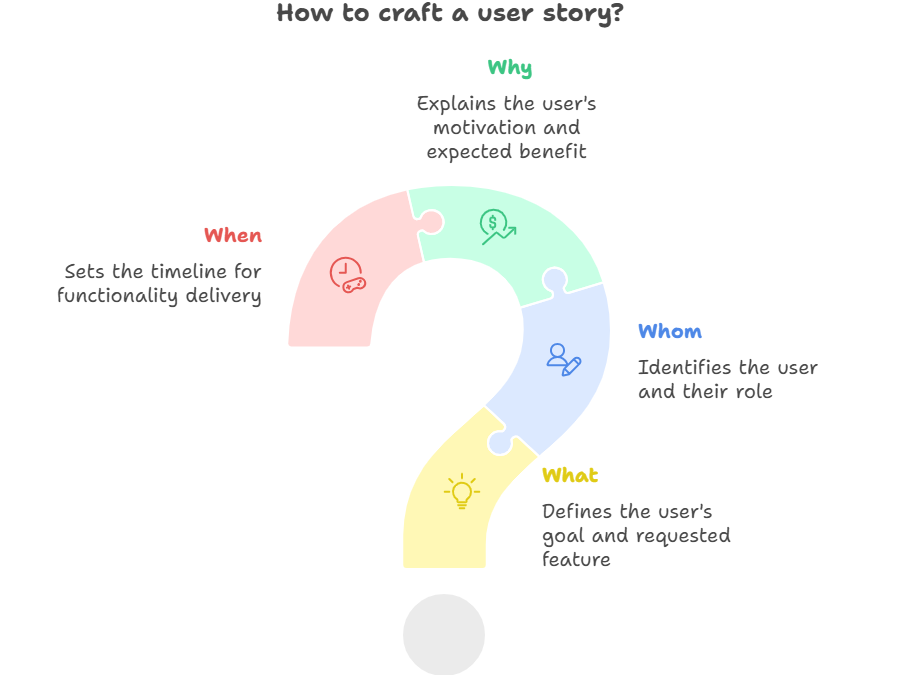
Answering the “What, Whom, Why, When”
A well-crafted user story should answer the following questions:
- What: What is the user trying to accomplish? What feature or functionality are they requesting?
- Whom: Who is the user? What is their role or persona?
- Why: Why does the user want this? What is the benefit or value they expect to receive?
- When: When does the user need this functionality? (This is less common but can be important for prioritization).
A common template for writing user stories is:
“As a [Whom], I want [What] so that [Why].”
Example:
“As a registered user, I want to be able to reset my password so that I can regain access to my account if I forget my password.”
Customer-Centric
User stories are inherently customer-centric. They force the development team to think about the user’s needs and goals. This focus helps to:
- Prioritize features: By understanding the value each feature provides to the user, the team can prioritize development efforts accordingly.
- Improve communication: User stories provide a common language for discussing requirements between the development team and stakeholders.
- Increase user satisfaction: By delivering features that directly address user needs, the team can increase user satisfaction.
Acceptance Criteria and Definition of Done (DoD) for Quality
While the user story itself is a high-level description, it’s crucial to define clear acceptance criteria and a Definition of Done (DoD) to ensure quality and clarity.
- Acceptance Criteria: These are specific, measurable, achievable, relevant, and time-bound (SMART) conditions that must be met for the user story to be considered complete and acceptable. They define the boundaries of the story and provide a clear understanding of what needs to be delivered.
- Example (for the password reset story):
- The user receives an email with a password reset link.
- The password reset link is valid for 24 hours.
- The user is able to set a new password that meets the password complexity requirements.
- The user is able to log in with the new password.
- Example (for the password reset story):
- Definition of Done (DoD): This is a checklist of activities that must be completed before a user story can be considered “done.” It ensures that all necessary steps have been taken to deliver a high-quality product.
- Example (general DoD):
- Code is written and reviewed.
- Unit tests are written and passing.
- Integration tests are written and passing.
- The code is deployed to a staging environment.
- The feature is tested and approved by the product owner.
- Documentation is updated.
- Example (general DoD):
INVEST Mnemonic
The INVEST mnemonic is a helpful guide for creating good user stories:
- Independent: The user story should be self-contained and not dependent on other stories. This allows the team to work on stories in any order.
- Negotiable: The user story is not a contract. It’s a starting point for a conversation between the development team and the product owner. The details can be negotiated and refined as needed.
- Valuable: The user story should deliver value to the user. It should address a real need or solve a real problem.
- Estimable: The user story should be small enough and clear enough that the development team can estimate the effort required to complete it.
- Small: The user story should be small enough to be completed within a single sprint. This helps to ensure that the team can deliver value frequently.
- Testable: The user story should be testable. It should be possible to write acceptance criteria that can be used to verify that the story has been completed correctly.
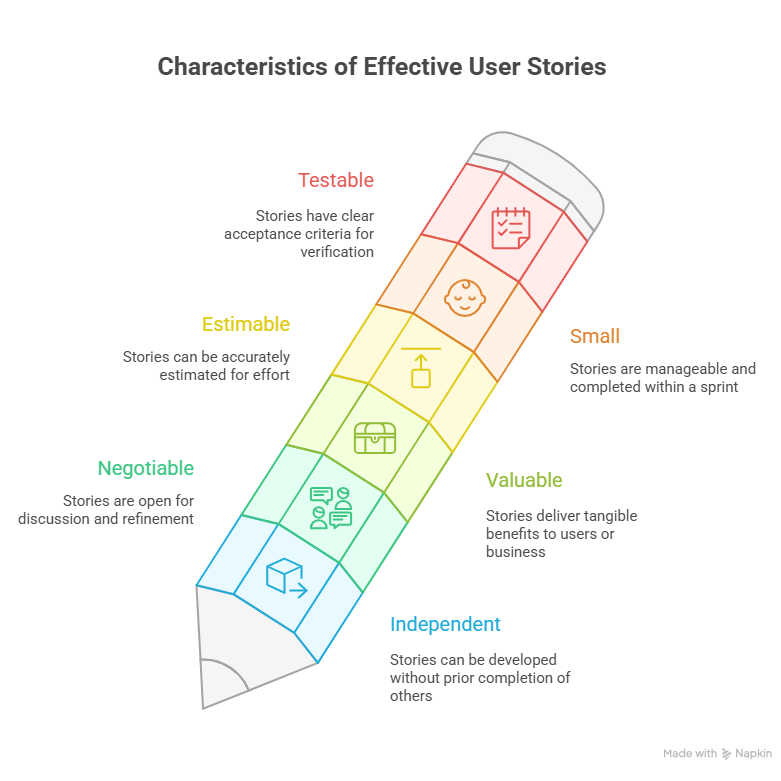
By adhering to the INVEST principles, you can create user stories that are clear, concise, and actionable, leading to more effective development and higher-quality products.
In conclusion, user stories are a powerful tool for capturing and communicating requirements in an Agile environment. By focusing on the customer’s perspective, answering the “what, whom, why, and when” questions, defining clear acceptance criteria and a Definition of Done, and applying the INVEST mnemonic, you can create user stories that drive value and ensure the delivery of high-quality software.