
| Check your PMP Eligibility | Check your PMI-ACP Eligibility | Register for PMP Course |
Understanding the Time Value of Money (TVM)
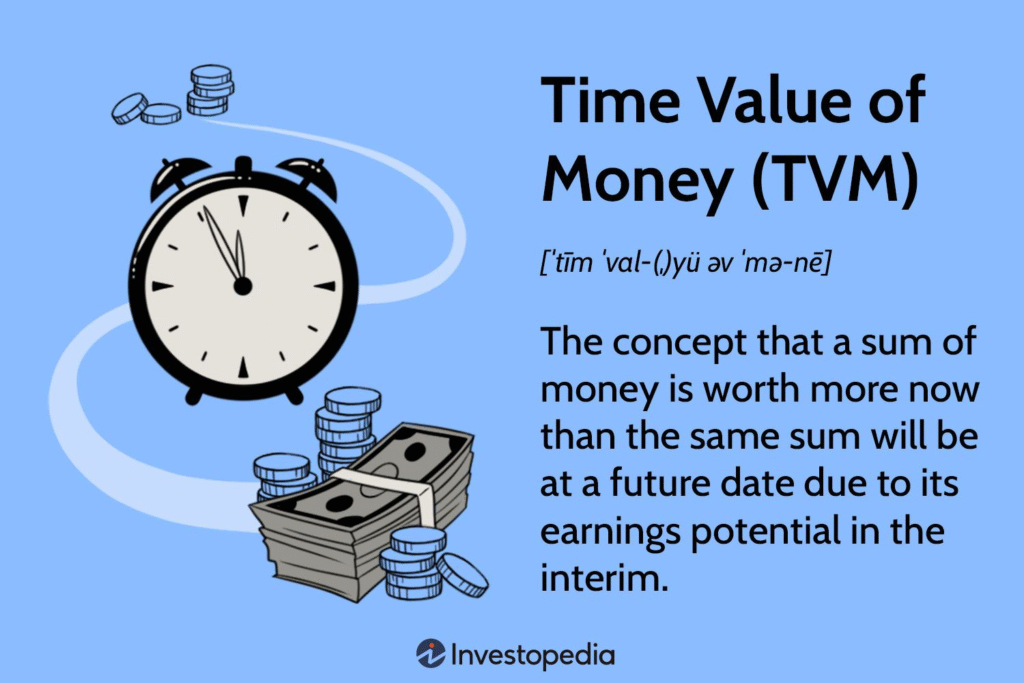
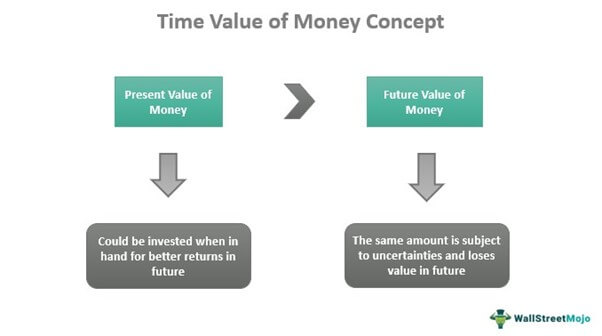
Money has a time value — a dollar today is worth more than a dollar tomorrow.
This idea is the foundation of Net Present Value vs Present Value comparison, because both depend on how we value money over time.
Money today can earn interest, be invested, or generate returns. This principle is called the Time Value of Money (TVM), and it forms the base for understanding Present Value (PV) and Net Present Value (NPV).
Example of Time Value of Money
If you have $1,000 today and invest it at 10% annual return, after one year you’ll have $1,100.
That means $1,000 today = $1,100 next year.
So if someone offers you $1,100 next year, its present value is $1,000 today.
This helps you understand why comparing Net Present Value vs Present Value is essential in investment decisions.
What Is Present Value (PV)?
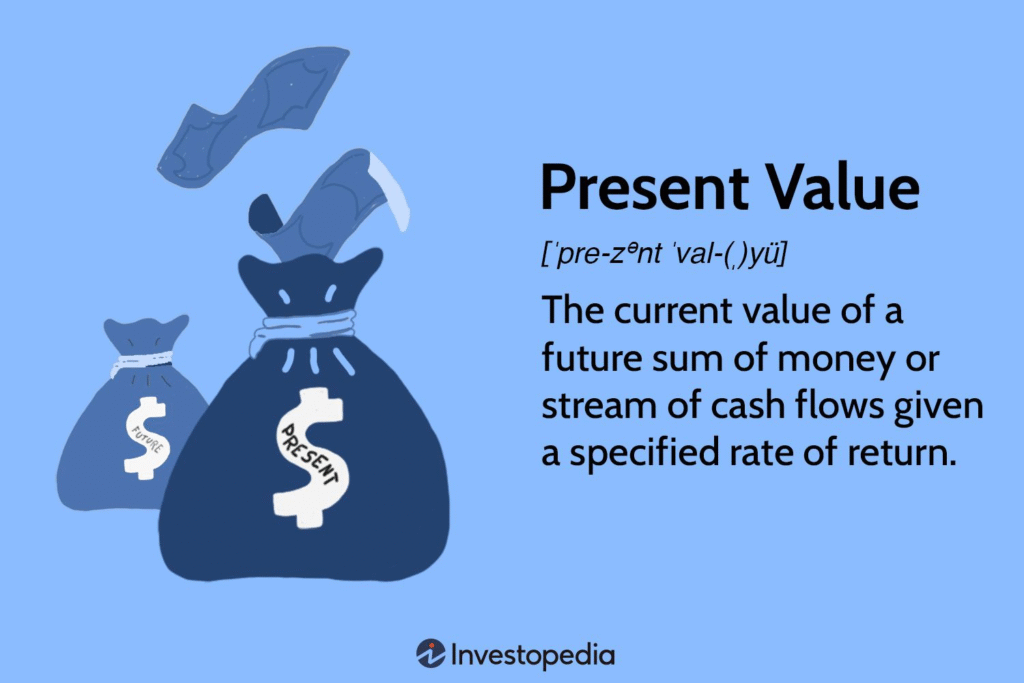
Present Value (PV) means the value today of a sum you expect to receive in the future. It is based on the time value of money — the idea that money today is worth more than the same amount tomorrow.
PV Formula
PV = Future Value / (1 + r)^nWhere:
- FV = Future Value
- r = Discount rate (interest rate or required return)
- n = Number of periods
Example of Present Value
If you expect to receive $100,000 one year from now and your required return is 7%, then:
PV = 100,000 / (1 + 0.07)^1 = $93,458So, $100,000 next year is worth $93,458 today.
Why PV Matters
PV helps you compare today’s money with future cash flows.
It’s useful for:
- Deciding between future and current payments
- Valuing bonds, savings, or receivables
- Financial planning and investment analysis
What Is Net Present Value (NPV)?
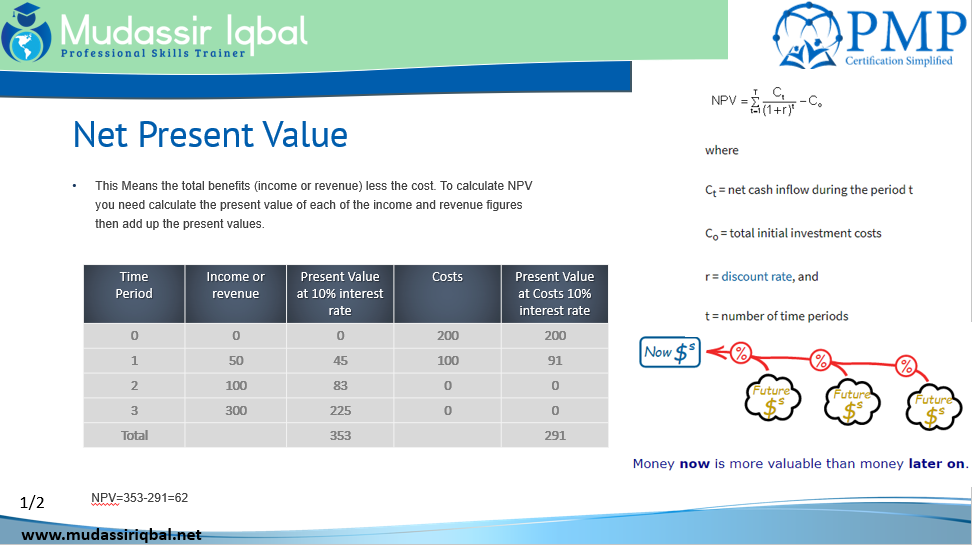
Net Present Value (NPV) goes a step further. It compares the total present value of inflows with the initial investment (outflow). It helps you decide if a project or investment adds real value. When you compare Net Present Value vs Present Value, NPV tells you whether an investment creates value beyond your initial spending.
NPV Formula
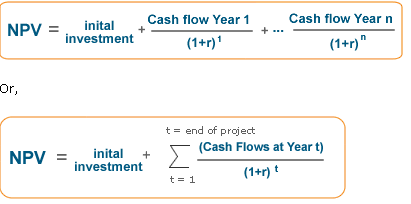
NPV = Σ [ Rt / (1 + r)^t ]

Where:- Rt = Net cash flow at time t (negative for investment, positive for returns)
- r = Discount rate
- t = Time period
Example of Net Present Value
You invest $5,000 today and expect $10,000 after 5 years. Discount rate = 10%
PV of inflow = 10,000 / (1 + 0.10)^5 = $6,210
NPV = 6,210 - 5,000 = +$1,210
A positive NPV means the investment is profitable.
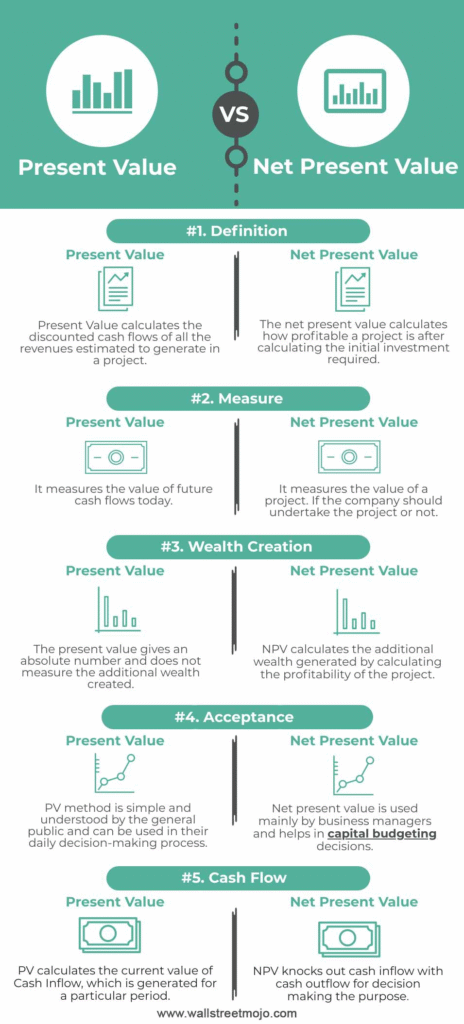
PV vs NPV: The Key Differences
| Feature | Present Value (PV) | Net Present Value (NPV) |
|---|---|---|
| What it shows | Value today of future money | Value added by an investment |
| Includes investment | No | Yes (includes outflow) |
| Use case | Valuing a single payment | Evaluating full project |
| Decision rule | None | Accept if NPV > 0 |
Step-by-Step Calculation Example
Let’s say a project has these cash flows:
- Year 0: Investment = $20,000
- Year 1: Inflow = $8,000
- Year 2: Inflow = $10,000
- Year 3: Inflow = $7,000
- Discount rate = 9%
Step 1:
PV (Year 1) = 8,000 / (1.09)^1 = $7,339
PV (Year 2) = 10,000 / (1.09)^2 = $8,418
PV (Year 3) = 7,000 / (1.09)^3 = $5,405
Step 2:
Sum of PVs = 7,339 + 8,418 + 5,405 = $21,162
Step 3:
NPV = 21,162 – 20,000 = +$1,162
Because NPV is positive, the project adds value.
Why PV and NPV Matter in Decision-Making
Understanding Net Present Value vs Present Value helps you make smarter business and financial decisions.
- PV shows what your future returns are worth today.
- NPV shows if a project or investment actually creates value.
Both are key in project management, budgeting, and investment planning.
Using PV and NPV makes your leadership and consulting decisions data-driven and defensible..
Key Takeaways
- Always use realistic discount rates and consistent time periods
- PV = Value of future money today
- NPV = PV of inflows minus PV of outflows
- Positive NPV → Project adds value
- Negative NPV → Project loses value
Further Readings
Payback Period, Sunk Cost and Opportunity Cost
Cost Benefit Analysis

🔍 Top PMP Keywords for 2025
These popular search terms are commonly used by professionals preparing for the PMP exam. Use them to guide your study or content strategy:
- ✅ Certification as a Project Management Professional
- ✅ PMP Certification Project Management Professional
- ✅ Project Management Professional Exam
- ✅ PMP Exam Prep Guide
- ✅ PMP Study Plan
- ✅ PMP Certification Cost
- ✅ PMP Test Tips
- ✅ Project Management Course
Tip: These keywords can help improve your understanding of key exam topics and align your prep with current industry search trends.
|
📚 Flash Cards/ PMP Practice Exam (Identify and fill your knowledge gaps) |
🧮 Formula Sheet |
🔄 Project Management Flows Understand the Big Picture |
📝 PMIs PMP Application |
|
🎲 Process Groups Game (First step into your ITTO Journey) |
⚡ Agile Project Management Flows | ||
|
🏅 Earn Your PDUs (Renew your Certification) |
📌 PMP Exam Content Outline Game (Begin your Journey here) |
📚 And More |
|